
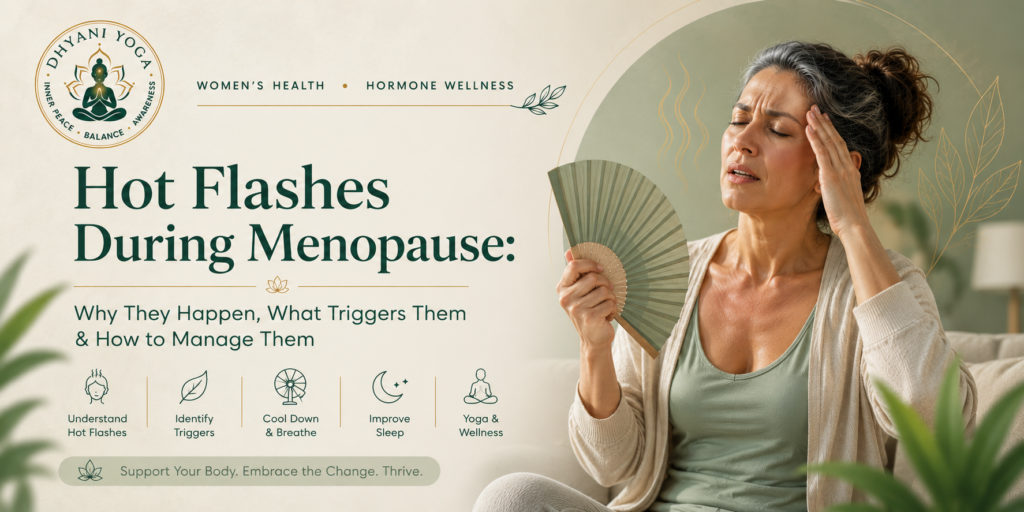
Hot flashes are one of the most recognizable symptoms of perimenopause and menopause—but understanding why they happen can make them much less mysterious. Learn about hot flash triggers, night sweats, stress, sleep, lifestyle strategies, medical treatment options, and how yoga may fit into a broader approach to menopause care.
That Sudden Wave of Heat Isn’t “Just in Your Head”
It can happen in the middle of a meeting.
You’re sitting comfortably, and suddenly your face feels warm.
Then your neck.
Then your chest.
Within moments, you may be sweating, your heart may feel like it’s beating faster, and you may desperately want to open a window.
And just as quickly as it arrived, the heat begins to disappear.
For many women, this is a hot flash.
During the night, a similar episode may wake you drenched in sweat, leaving you uncomfortable, frustrated and exhausted the following morning. These nighttime episodes are commonly referred to as night sweats.
Hot flashes and night sweats are among the most common symptoms associated with the menopausal transition. They can begin during perimenopause and, for some women, continue for years.
But why does a hormonal transition cause your body to suddenly feel as though someone turned up the thermostat?
And perhaps more importantly:
What can you actually do about it?
What Is a Hot Flash?
A hot flash—also called a hot flush or, medically, a vasomotor symptom is a sudden sensation of heat, usually affecting the upper body, particularly the face, neck and chest.
It may be accompanied by:
- Sweating
- Flushing or redness
- Chills afterward
- Heart palpitations
- Anxiety or a feeling of unease
- Physical discomfort
Episodes can vary considerably from person to person. Some may be relatively mild, while others can be intense enough to interrupt work, sleep and everyday activities.
And there is no single “normal” number of hot flashes.
Some women experience them occasionally.
Others experience them several times a day.
For some, the most disruptive episodes happen at night.
Why Do Hot Flashes Happen During Menopause?
This is where things get interesting.
Hot flashes aren’t simply caused by “low estrogen.”
The menopausal transition involves changes in ovarian hormone production, including declining estrogen levels. Those hormonal changes can affect systems involved in temperature regulation.
Your brain contains a region called the hypothalamus, which plays an important role in regulating body temperature.
Think of it as part of your body’s internal thermostat.
Normally, your body can tolerate a relatively broad range of temperatures without triggering a major cooling response.
During menopause, changes in the body’s thermoregulatory system can narrow this temperature range.
As a result, relatively small changes in core temperature may trigger a response designed to cool the body.
Blood vessels in the skin can widen.
Sweating can increase.
You may suddenly feel intensely hot.
And that is the experience we recognize as a hot flash.
Researchers describe this as a change in the thermoregulatory neutral zone.
So when you experience a hot flash, your body isn’t necessarily “overheating.”
Your temperature-regulation system may simply be responding differently.
Why Are Hot Flashes Worse During Perimenopause?
You don’t necessarily have to reach menopause before experiencing hot flashes.
They can begin during perimenopause, the years leading up to menopause.
During this transition, menstrual cycles can become irregular and reproductive hormone levels can fluctuate. Hot flashes and other symptoms can begin during this period.
For some women, the first clue that something is changing isn’t a missed period.
It may be:
“Why am I suddenly waking up covered in sweat?”
or:
“Why am I getting these strange waves of heat?”
Perimenopause can last for several years, so symptoms may change in frequency and intensity over time.
Hot Flash vs. Night Sweat: What’s the Difference?
The terms are often used interchangeably, but there is a practical distinction.
Hot flash
A sudden episode of heat that can occur during the day or night.
Night sweat
A hot flash that occurs during sleep and causes significant sweating.
Night sweats can be particularly frustrating because they can wake you repeatedly.
That creates another problem:
Hot flash → waking → disrupted sleep → daytime fatigue
And then poor sleep can affect concentration, mood and how resilient you feel the next day. ACOG notes that nighttime hot flashes can disrupt sleep and contribute to daytime tiredness.
Why Do Hot Flashes Happen at Night?
Nighttime can make hot flashes especially disruptive.
You are lying in bed.
The room may already be warm.
You’re under blankets.
And then a sudden wave of heat arrives.
You wake up sweating.
You throw off the covers.
A few minutes later, you’re cold.
You get comfortable again.
And then it happens again.
This cycle can make menopause-related sleep problems feel like an entirely separate health issue.
In reality, hot flashes and sleep can be closely connected.
That’s why managing nighttime triggers and creating a supportive sleep environment can be an important part of managing menopause symptoms.
What Can Trigger a Hot Flash?
Not every hot flash has an obvious trigger.
However, some women notice that certain situations make episodes more likely or more uncomfortable.
Potential triggers can include:
Spicy foods
Some people notice increased symptoms after eating spicy foods.
Caffeine
Coffee, tea and other caffeinated beverages may trigger symptoms for some women.
Alcohol
Alcohol can trigger or worsen hot flashes in some people.
Heat
Warm rooms, heavy clothing and excessive bedding can make an episode more uncomfortable.
Stress
Stress and emotional arousal may coincide with or intensify symptoms for some women.
Smoking
Smoking is associated with several health risks and may also worsen menopausal symptoms.
ACOG recommends practical measures such as wearing removable layers, keeping cool, drinking cold beverages and identifying individual triggers. It also notes alcohol and caffeine as possible triggers for some women.
But remember:
Your trigger may not be someone else’s trigger.
Instead of following a huge list of foods you “must never eat,” pay attention to your own patterns.
Become a Detective: Track Your Hot Flashes
One of the simplest things you can do is start observing your symptoms.
For two or three weeks, note:
Time: When did it happen?
Location: Where were you?
Temperature: Was the environment warm?
Food: What had you eaten or drunk?
Caffeine: Had you consumed coffee or tea?
Alcohol: Had you been drinking?
Stress: Were you anxious, rushed or emotionally activated?
Sleep: How well did you sleep the night before?
Menstrual cycle: If you’re still having periods, where were you in your cycle?
You may begin to notice patterns.
And those patterns can give you something useful to discuss with your healthcare professional.
ACOG also provides a menopause symptom tracker specifically designed to help people document symptoms and discuss them with their ob-gyn.
What Can You Do During a Hot Flash?
When a hot flash begins, the goal is simple:
Get comfortable and help your body cool down.
You might:
- Remove a layer of clothing.
- Move somewhere cooler.
- Use a fan.
- Sip a cool drink.
- Reduce heavy bedding at night.
- Take slow, comfortable breaths.
- Give yourself a moment rather than panicking about the sensation.
ACOG recommends cooling strategies such as removable layers, portable fans and cold drinks as practical approaches that may help.
And remember:
A hot flash will pass.
You don’t have to fight the sensation.
You can notice it, cool down and allow your body to settle.
Can Stress Make Hot Flashes Worse?
This is an area worth paying attention to.
Menopause isn’t occurring in a vacuum.
You may be managing work, family responsibilities, changing relationships, sleep disruption and your own concerns about your changing body all while experiencing hormonal changes.
Stress can also make you more aware of physical sensations.
That doesn’t mean:
“Your hot flashes are caused by stress.”
It means that stress, sleep disruption and menopausal symptoms can interact.
This is where mind-body practices may become useful—not because they “reset your hormones,” but because they can support relaxation, movement and overall well-being.
Can Yoga Help With Hot Flashes?
This is where Dhyani takes a different approach from much of the wellness internet.
You will find claims online such as:
“Do these five poses and stop hot flashes.”
That’s far too simplistic.
Yoga is not a guaranteed cure for hot flashes.
Research does suggest that yoga may help reduce overall menopause symptoms, and earlier reviews have found improvements in physical and psychological symptoms.
However, a 2024 systematic review and meta-analysis of 24 randomized controlled trials involving more than 2,000 participants found improvements in several menopausal outcomes, including sleep and psychological symptoms, but did not find a statistically significant difference between yoga and usual care specifically for hot flashes.
That’s an important distinction.
At Dhyani Yoga, we believe the goal isn’t to promise a magical pose.
It is to use yoga as one complementary tool within a broader approach to health.
Where Yoga May Fit Into Your Menopause Routine
Yoga combines movement, breathing and, depending on the style, relaxation or meditation.
For someone navigating menopause, a suitable practice may help support:
- Regular physical activity
- Mobility
- Balance
- Stress management
- Body awareness
- Relaxation
- Sleep routines
- General well-being
Research summarized by the U.S. National Center for Complementary and Integrative Health suggests yoga may relieve menopause symptoms and appears to be at least as effective as other forms of exercise for overall menopausal symptoms.
But your practice should match your body.
If you are experiencing a hot flash, you don’t need to force yourself through an intense sequence.
Sometimes the better choice is:
Slow movement → comfortable breathing → cooling down → rest.
What About Hot Yoga?
This deserves its own warning.
If you’re experiencing frequent hot flashes, deliberately practicing in a very hot environment may not be the obvious choice.
Hot yoga involves additional heat exposure, and NCCIH notes that hot yoga carries particular risks related to overheating and dehydration.
If heat is already one of your biggest symptoms, consider a cooler environment and a practice that allows you to regulate your comfort.
What About Breathing Exercises?
Breathing practices are often included in yoga and relaxation routines.
A simple approach is to focus on slow, comfortable breathing without forcing the breath or holding it for long periods.
For example:
A simple calming breath
Sit or lie comfortably.
Relax your shoulders.
Breathe in gently through your nose.
Allow the breath to leave slowly and comfortably.
Repeat for several cycles.
The purpose isn’t to “switch off” a hot flash instantly.
Instead, it can give you something steady to focus on while your body settles.
If a breathing exercise makes you dizzy, uncomfortable or anxious, stop and return to normal breathing.
What About Meditation?
Meditation is another complementary practice that some women explore during menopause.
ACOG notes that some women find meditation helpful for hot flashes.
The goal isn’t necessarily to make the hot flash disappear.
Instead, meditation may help you develop a different relationship with the physical sensation:
Notice → breathe → respond → recover.
That can be especially valuable when anxiety about the next hot flash becomes part of the experience.
Lifestyle Strategies That May Help
There isn’t one universal menopause routine.
But several practical habits can make symptoms easier to manage.
Keep Your Environment Cool
Use fans, breathable bedding and removable layers.
Dress in Layers
Layers make it easier to respond quickly when a hot flash begins.
Identify Your Triggers
Instead of eliminating everything from your diet, track what actually affects you.
Pay Attention to Alcohol and Caffeine
If you notice a relationship between these and your symptoms, consider reducing them and discuss persistent symptoms with your healthcare professional.
Stay Physically Active
Regular physical activity supports overall health during midlife and beyond.
Yoga can be one component, but it doesn’t have to be your only form of exercise.
Prioritize Sleep
If nighttime hot flashes are repeatedly waking you, don’t treat sleep disruption as something you simply have to accept.
Discuss persistent or severe sleep problems with a healthcare professional.
When Lifestyle Changes Aren’t Enough
Here’s something important:
You don’t have to “tough it out.”
If hot flashes are frequent, intense or interfering with your sleep, work, relationships or quality of life, medical treatment options exist.
Treatment may include:
Hormone therapy
Hormone therapy is considered one of the most effective treatments for menopausal vasomotor symptoms. Whether it is appropriate depends on your individual medical history, age, timing, risks and preferences.
Non-hormonal medications
Several prescription options may help reduce hot flashes.
Current guidance includes non-hormonal approaches for people who cannot or do not wish to use hormone therapy. NICE’s updated guidance includes menopause-specific CBT as an option and recommends fezolinetant for certain people with moderate to severe vasomotor symptoms when hormone replacement therapy is unsuitable.
Menopause-specific cognitive behavioral therapy
CBT is another evidence-based option that can help some people manage the impact of vasomotor symptoms, particularly when symptoms affect sleep, mood and quality of life.
The right treatment is personal.
A healthcare professional can help you weigh the benefits and risks based on your health history.
What About “Natural” Remedies for Hot Flashes?
This is where you should be careful.
The internet is full of:
- Herbal supplements
- “Hormone-balancing” powders
- Detox products
- Essential oils
- Phytoestrogen products
- Black cohosh
- Soy supplements
- “Cortisol-balancing” products
Natural does not automatically mean safe.
NCCIH notes that evidence for many supplements used for menopause symptoms remains limited, and supplements can have side effects or interact with medications.
If you’re considering a supplement for hot flashes, talk with a qualified healthcare professional—especially if you take medications or have an existing medical condition.
When Should You See a Doctor About Hot Flashes?
Consider talking with a healthcare professional if:
- Hot flashes are interfering with your sleep.
- They are affecting your work or daily activities.
- You are experiencing severe or persistent symptoms.
- You are unsure whether your symptoms are related to menopause.
- Your symptoms suddenly change.
- You are experiencing other symptoms that concern you.
- You want to discuss hormone therapy or non-hormonal treatment.
- You are considering supplements or other complementary treatments.
And don’t automatically assume every episode of sweating or flushing is menopause.
Other medical conditions and medications can cause similar symptoms. A healthcare professional can help determine whether menopause is the likely explanation.
A Special Note About Bleeding
Hot flashes may be a normal part of the menopausal transition.
Unexpected bleeding is a different matter.
If you have reached menopause—meaning you have had 12 consecutive months without a menstrual period—and then experience vaginal bleeding, including spotting, it should be evaluated by a healthcare professional.
Don’t simply assume it is another menopause symptom.
Your Menopause Toolkit
There is no single solution for every woman.
Instead, think of your menopause toolkit as a combination of strategies:
Understand
Learn what is happening in your body.
Track
Notice patterns and potential triggers.
Cool
Create an environment that helps you manage sudden heat.
Move
Stay physically active in ways that suit your body.
Breathe
Use comfortable breathing practices as part of relaxation.
Sleep
Protect your nighttime routine and address persistent sleep disruption.
Talk
Discuss significant symptoms with a healthcare professional.
Personalize
What works for one woman may not work for another.
A Gentle Dhyani Practice for Hot-Flash Days
Not every day needs to be a workout.
On days when you’re experiencing frequent hot flashes or feeling depleted, consider a gentle practice focused on:
1. Settling
Take a comfortable seated position and notice your breathing.
2. Gentle mobility
Move through slow, pain-free neck, shoulder and spinal movements.
3. Comfortable movement
Choose simple yoga movements that do not leave you overheated.
4. Slow breathing
Practice relaxed breathing without forcing the inhale or exhale.
5. Rest
Finish with a few quiet minutes of relaxation.
The goal is not:
“Make my hormones normal.”
The goal is:
“Give my body space to move, breathe and recover.”
The Bigger Picture: Hot Flashes Are Only One Part of Menopause
A hot flash can be frustrating.
But menopause is about much more than temperature.
The transition can intersect with:
Sleep
Mood
Brain fog
Body composition
Muscle health
Bone health
Cardiovascular health
Sexual health
Stress
Quality of life
That’s why managing menopause isn’t about finding one miracle solution.
It’s about building a health strategy that evolves with you.
You Don’t Have to Fight Your Body
Your body isn’t malfunctioning because you’re experiencing menopause.
It’s changing.
And understanding that change gives you more choices.
You can learn your triggers.
You can improve your sleep environment.
You can stay active.
You can explore relaxation and mind-body practices.
You can seek medical treatment when symptoms become disruptive.
And you can ask for help without feeling that you’re somehow failing.
Menopause isn’t something you have to navigate blindly.
The more you understand your body, the more confidently you can care for it.
Explore Dhyani Yoga’s Hormone Reset Series
If you’re experiencing hot flashes, brain fog, sleep changes or other symptoms associated with perimenopause and menopause, explore the Dhyani Yoga Hormone Reset Series.
Episode 1 — Brain Fog
Understanding why concentration and mental clarity can feel different during the menopausal transition.
Episode 2 — Hot Flashes
A focused practice and educational discussion around one of the most common menopause symptoms.
Episode 3 — Weight Shifts & Metabolism
Understanding changes in body composition and metabolic health during menopause.
Episode 4 — Reclaiming Your Body: Menopause & Beyond
The series finale explores healthy aging and moving forward with greater awareness of your changing body.
[Explore the Hormone Reset Series →]
Frequently Asked Questions
What causes hot flashes during menopause?
Hot flashes are associated with hormonal changes during the menopausal transition, particularly changes in estrogen, which can affect the body’s temperature-regulation system. The thermoregulatory system may become more sensitive to small changes in core temperature, triggering sweating and blood-vessel changes.
Can hot flashes start during perimenopause?
Yes. Hot flashes can begin during perimenopause, sometimes before periods have stopped completely.
Why are my hot flashes worse at night?
Nighttime hot flashes can cause sweating and repeated awakenings, disrupting sleep. Environmental heat, bedding and individual triggers may also influence how uncomfortable nighttime episodes feel.
How can I reduce hot flashes naturally?
Practical approaches can include staying cool, dressing in layers, identifying personal triggers, and incorporating appropriate physical activity and relaxation practices. However, “natural” does not necessarily mean effective or safe, and persistent or severe symptoms should be discussed with a healthcare professional.
Can yoga stop hot flashes?
There is not enough evidence to claim that yoga reliably stops hot flashes. Research suggests yoga may help with overall menopausal symptoms, while evidence specifically for reducing hot flashes is mixed. A 2024 systematic review found benefits across several menopausal outcomes but no significant difference in hot flashes compared with usual care.
Is yoga safe during menopause?
Yoga is generally considered a safe form of physical activity when appropriately practiced, but injuries can occur. People with health conditions may need modifications, and hot yoga carries additional risks related to overheating and dehydration.
What is the most effective treatment for hot flashes?
Hormone therapy is among the most effective treatments for menopausal vasomotor symptoms, but it is not appropriate for everyone. Non-hormonal treatments are also available. The appropriate option depends on your health history, symptoms, preferences and individual risks.
Do caffeine and alcohol trigger hot flashes?
They can trigger or worsen hot flashes for some women. Rather than assuming they are triggers for everyone, track your individual response.
How long do hot flashes last?
There is substantial variation. Some women experience symptoms for a relatively short period, while others experience them for several years. Hot flashes may begin during perimenopause and continue into postmenopause for some women.
Medical Disclaimer
This article is intended for general educational and informational purposes only. It is not medical advice, diagnosis or treatment and should not replace consultation with a qualified healthcare professional.
Menopause symptoms vary from person to person. Other medical conditions and medications can cause symptoms that resemble hot flashes or night sweats.
Do not start, stop or change medication, hormone therapy, supplements or other treatment based solely on information in this article.
If hot flashes are severe, persistent, affecting your sleep or daily life, or accompanied by other concerning symptoms, speak with an appropriately qualified healthcare professional.
Yoga and other complementary practices should be considered part of a broader approach to health and should not be used as a replacement for appropriate medical care.
Evidence & References
The article was prepared using information from recognized health and medical organizations and peer-reviewed research, including:
- World Health Organization (WHO) — Menopause and the menopausal transition.
- American College of Obstetricians and Gynecologists (ACOG) — Hot flashes, menopause symptoms and treatment options.
- National Institute for Health and Care Excellence (NICE) — Menopause: identification and management, including current guidance for vasomotor symptoms.
- National Center for Complementary and Integrative Health (NCCIH) — Evidence on yoga and complementary approaches for menopausal symptoms.
- Peer-reviewed systematic review and meta-analysis, 2024 — Yoga interventions and menopausal symptoms.
About Dhyani Yoga
Dhyani Yoga is a modern yoga and wellness education platform focused on helping people understand their bodies, build sustainable movement practices and develop a deeper relationship between physical and mental well-being.
Our approach brings together yoga, movement, breathwork, mindfulness and health education—without promising quick fixes or replacing appropriate medical care.
Understand your body. Move with awareness. Breathe with intention. Live well.